







How Tactical Helmets Evolved
There was a time when a helmet’s job was simple — keep shrapnel out and your head intact. The PASGT, MICH, and ACH helmets defined that era: heavy, rugged, dependable. But as battlefields and missions changed, so did priorities.
Modern combat isn’t just kinetic — it’s digital, fast, and connected. The FAST (Future Assault Shell Technology) system represents that shift. Today, the helmet is more than protection — it’s the platform for your entire tactical ecosystem.
Old-School Helmets: The Age of Pure Protection
Classic ballistic helmets like the PASGT (Personnel Armor System for Ground Troops) or MICH 2000 are still respected for their ballistic reliability. They were designed to stop fragments and low-velocity rounds, not to hold accessories or electronics.
They’re heavier — often 1.5 to 1.8 kg, depending on shell material — and use simple aramid (Kevlar) layers. Their suspension systems rely on thick pads and webbing, which absorb impact but lack fine-tuned comfort.
They protect well, but that’s all they do. Try adding night vision, comms, or cameras, and you’ll meet their limits fast.
Modern FAST Systems: The Modular Brain of the Operator
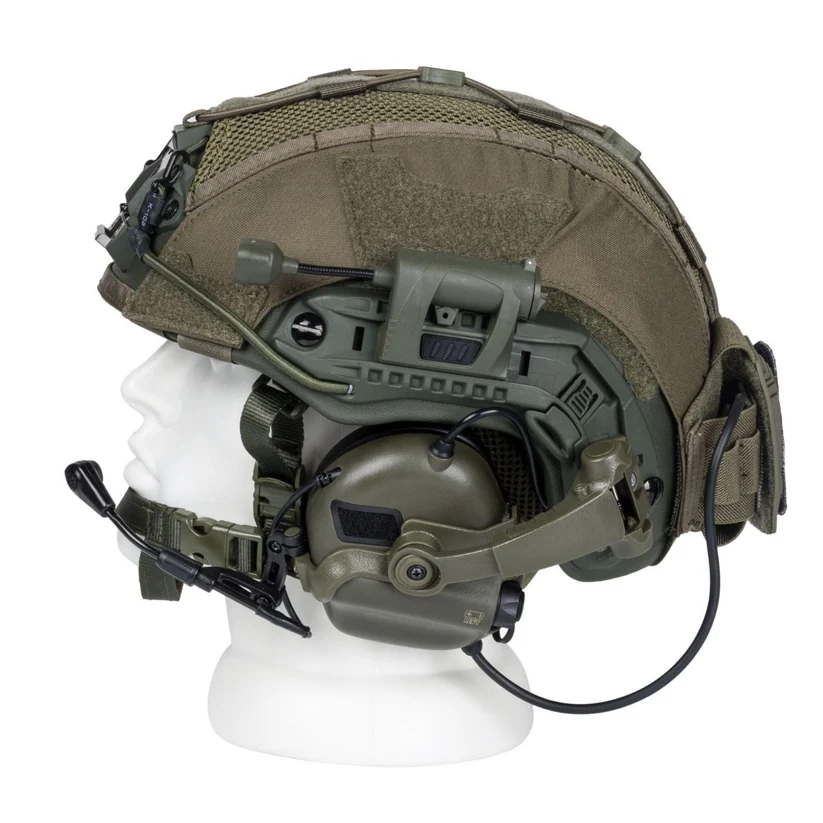
Then came the Ops-Core FAST, Team Wendy EXFIL, and Earmor Helmet Systems — game changers in every sense.
Built from advanced composite materials like aramid-polyethylene hybrids, they achieve equal or better ballistic resistance while cutting weight by up to 25–30%.
But the real difference lies in integration. FAST helmets feature:
- Side rails for comms headsets, strobes, and IR markers.
- NVG shrouds compatible with PVS-14, GPNVG-18, or digital night vision units.
- Velcro and hook panels for IDs, counterweights, or battery packs.
- Ventilated comfort liners and dial-fit retention systems, replacing the rigid webbing of old designs.
The result: a helmet that’s no longer a passive shell but an active part of your system — one that links your Peltor or Earmor headset, your night vision, and your comms network in a single, ergonomic setup.
Performance in Motion: Balance, Weight, and Fatigue
Ask anyone who’s worn both: the difference isn’t subtle. Old-school helmets pull backward with NVG weight. Their center of gravity is high, which strains the neck and traps heat. FAST helmets, on the other hand, are engineered for balance — the geometry of the shell distributes weight evenly. You can mount a headset and NVG for hours without pressure points.
Operators describe it as the shift from “carrying gear” to “wearing a system.”
Compatibility and the Rise of the Full Tactical Suite
A helmet is no longer standalone equipment. It’s a hub. The FAST ecosystem integrates with comms-ready headsets like the Earmor M32H, Peltor ComTac XPI, and Sordin Supreme Pro-X — directly mounted via rail adapters. This modularity removes the bulk of overlapping headbands and improves situational awareness by aligning ear protection with radio communication.
For night operations or training, you can add:
- NVG arms and counterweights for balance.
- Lights, cameras, or IFF strobes for coordination.
- Internal wiring for silent comms routing.
It’s the difference between an operator adapting to gear, and gear adapting to the operator.
Cost vs. Capability
A standard PASGT replica might cost €150–€250, while a full FAST setup with rails, pads, and mounts can exceed €800–€1,000. But the investment isn’t just in materials — it’s in capability. With a modern system, one helmet replaces multiple tools: headset mounts, NVG integration, and improved ergonomics mean fewer compromises and better performance under stress.
The 2025 Verdict: Why FAST Wins the Future
Old-school helmets still have their place — especially for training or reenactment — but for any modern tactical application, they’re obsolete by design.
FAST systems embody the principles of 2025 warfare and training: lightweight modularity, instant adaptability, and total integration.
Choosing a FAST helmet isn’t about chasing the newest trend. It’s about adopting a platform — one that evolves with your mission, connects your gear, and keeps you operational longer, safer, and smarter. In 2025, your helmet isn’t just a piece of armor. It’s the core of your tactical network


